


Orchestrate What You Already Own: Why Carriers are turning to Overlay Orchestration
Ask any carrier how long it takes to deliver a new cloud connection to an enterprise customer, and the answer will often be measured in weeks. The fibre is in the ground, the ports are in the rack, and the capacity is available. What slows things down is everything around the network: an order re-entered into multiple systems, engineers configuring equipment from different vendors, and a billing record created after the service is already live.
This is the problem overlay orchestration was built to solve. Instead of replacing a carrier’s infrastructure, it sits above it, connecting existing systems and coordinating them as a programmable network.
For carriers, data centre operators and managed service providers, that creates an opportunity to deliver more services from the infrastructure they already own.
Why carrier networks are hard to automate
Carrier networks are rarely built in one go. They grow through acquisitions, equipment upgrades and partnerships over many years. The result is usually a mix of vendors, separate operational and business support systems, and partner interconnections that each work differently.
Traditional network management tools tend to focus on a particular vendor or network domain. They can monitor devices and apply configurations, but they do not necessarily coordinate the full customer journey from quote to activation to invoice.
Carriers are left with islands of automation: individual scripts and tools connected by people, spreadsheets and support tickets. Each manual handover adds time, cost and another opportunity for error.
What an overlay approach changes
An orchestration overlay works above the vendor layer. It connects to existing devices, controllers and business systems through APIs, then coordinates supported functions within an end-to-end workflow. Carriers can introduce automation without first replacing their equipment or standardising on a single vendor.
The practical effect is that a service becomes something a provider can define once and deliver repeatedly.
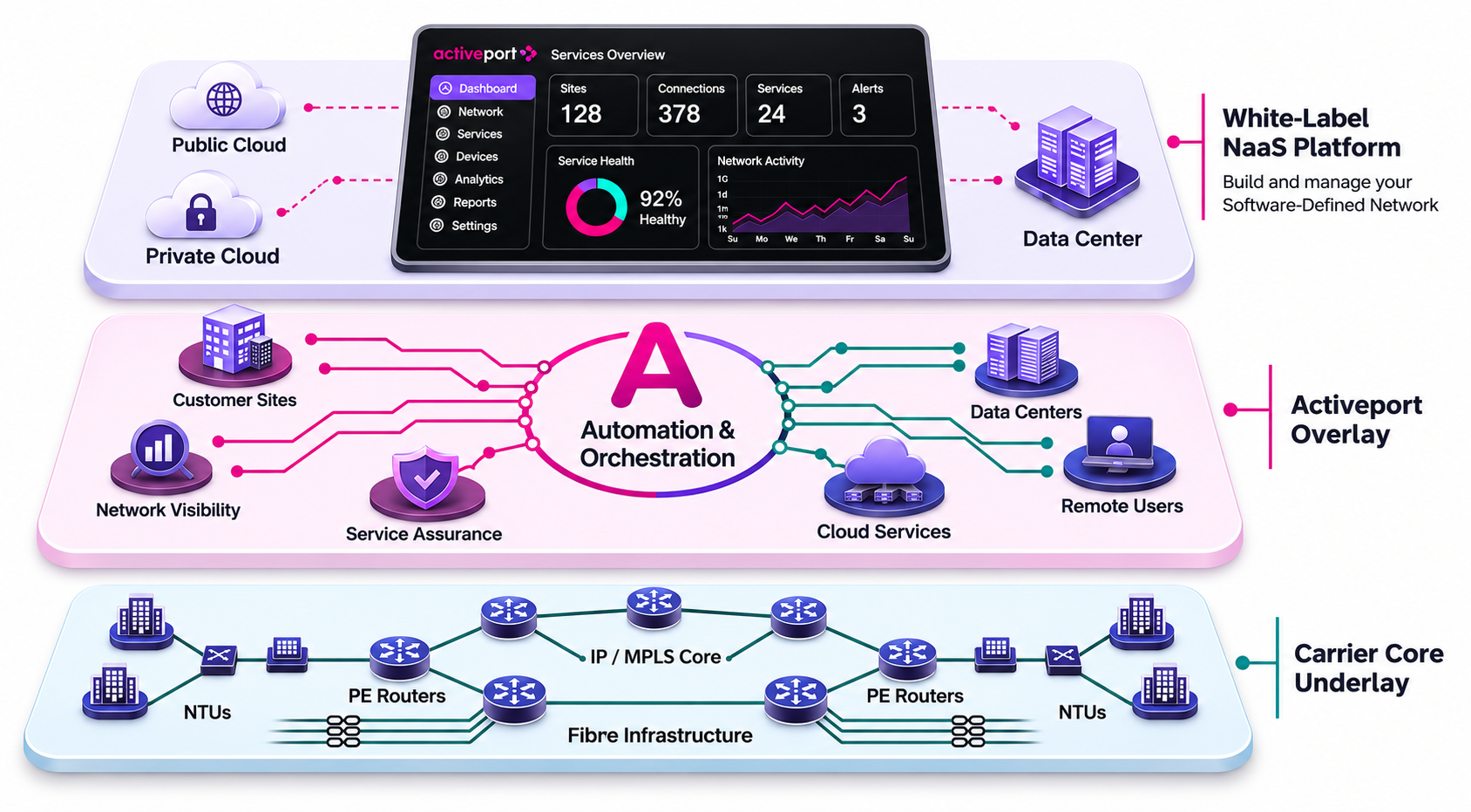
Activeport’s overlay orchestration connects existing carrier infrastructure with cloud services and a white-label customer platform.
A connection from a data centre to a cloud provider, for example, can follow a coordinated workflow: validate the order, confirm pricing, reserve available resources, configure the network path, activate monitoring, trigger billing and notify the customer.
Where the necessary integrations and resources are available, provisioning can move from weeks to minutes. Validated workflows reduce configuration errors, while services that previously required too much manual effort can become viable on-demand products.
Where Activeport’s overlay software fits
Activeport is an Australian software company providing overlay orchestration for carriers, data centre operators and managed service providers.
Its on-premises software powers a white-label orchestration platform, helping providers offer on-demand products such as access ports, data centre interconnect, cloud connectivity, port-to-port connections, multi-cloud services, GPU orchestration, partner network services and IP transit.
At its core is Activeport’s Management and Orchestration (MANO) platform, which coordinates business systems, network infrastructure and cloud services through API integrations. This vendor-neutral approach helps providers bring different environments into a common service delivery workflow.
The customer-facing ActivePortal interface brings ordering, provisioning, billing, trouble tickets, network visibility, bandwidth policies and customer relationship management into one place. Connecting these functions helps providers streamline the journey from quote to payment and give customers greater control over their services.
Because the platform is white-labelled, providers can present the portal under their own brand. They can expand their service catalogue across their network, cloud connections and carrier partners while maintaining the customer relationship.
Data centres are another strong use case. Activeport can coordinate connection requests and associated provisioning workflows within and between facilities, alongside access to cloud providers such as AWS, Google Cloud and Oracle Cloud. Its marketplace ordering capabilities also allow data centre customers to request cross-connects, colocation racks and other services through a single portal.
AI is rewriting the rules on bandwidth
AI workloads are adding a new dimension to network demand.
Training a model can involve moving large datasets between storage, GPU clusters and cloud environments in short, intensive bursts. Capacity requirements may rise sharply during a training run, then fall once the work is complete. Inference workloads can create different demands, with traffic shifting toward the edge and fluctuating with user activity.
Fixed, long-term capacity can be a poor match for these patterns. Organisations may pay for bandwidth that sits idle between jobs or face constraints when a training run or product launch needs additional capacity.
Enterprises and AI providers increasingly need the flexibility to connect GPU resources in one data centre to data in another, access cloud services and adjust bandwidth as workloads change.
Delivering that flexibility depends on more than available network capacity. Ordering, resource allocation, configuration and service activation need to work together. End-to-end orchestration makes these changes practical at scale.
Activeport includes GPU orchestration alongside its data centre interconnect and cloud connectivity capabilities, bringing these requirements into the broader orchestration workflow.
For carriers, the opportunity extends beyond selling more bandwidth. It is about making connectivity easier to order, faster to activate and more adaptable to the way AI customers operate.
Getting started without a big-bang project
An overlay approach can be introduced incrementally.
A practical starting point is one service with high demand and significant manual effort, such as cloud connectivity or data centre interconnect. Map the process from order through to activation and billing, identify the systems involved, and automate the supported steps.
Once that workflow is reliable, extend the approach to additional products, network domains and partner connections.
A few foundations matter. Accurate inventory gives the platform visibility of available resources. Clear service definitions establish what customers can order and how it should be delivered. Staged rollouts and tested rollback procedures help teams introduce automation in a controlled way.
Carriers have already invested heavily in their infrastructure. Overlay orchestration helps turn that investment into services that are easier to buy, faster to deliver and simpler to manage.
Talk to Activeport about bringing your existing network, business systems and customer services together through overlay orchestration.
