


More Than a Portal: Turning Self-Service into a Commercial Advantage
Many carriers already have a customer portal. Customers can log in, view their services and submit an order. But behind the screen, that order often lands in a ticket queue, where someone re-enters the details, schedules an engineer and eventually emails a confirmation.
The interface is digital, but the delivery process still runs at human speed.
True self-service goes further. It connects the customer’s request directly to the systems that deliver the service, turning the portal into a place where customers can order, activate and manage connectivity.
For carriers, data centre operators and managed service providers, that connection changes both the customer experience and the economics of service delivery.
Connecting the portal to the network
An overlay orchestration platform links the customer-facing portal to the network infrastructure and business systems behind it.
When a customer orders an eligible service, the orchestration layer can validate the request, check available resources, configure the network path, activate monitoring and trigger billing. Routine orders can move through a predefined workflow, with staff handling exceptions or requests that require additional review.
Activeport brings these capabilities together through its overlay orchestration software and ActivePortal interface. Providers can connect ordering, provisioning and service management within a portal presented under their own brand.
The value comes from what happens after the customer clicks “order”.
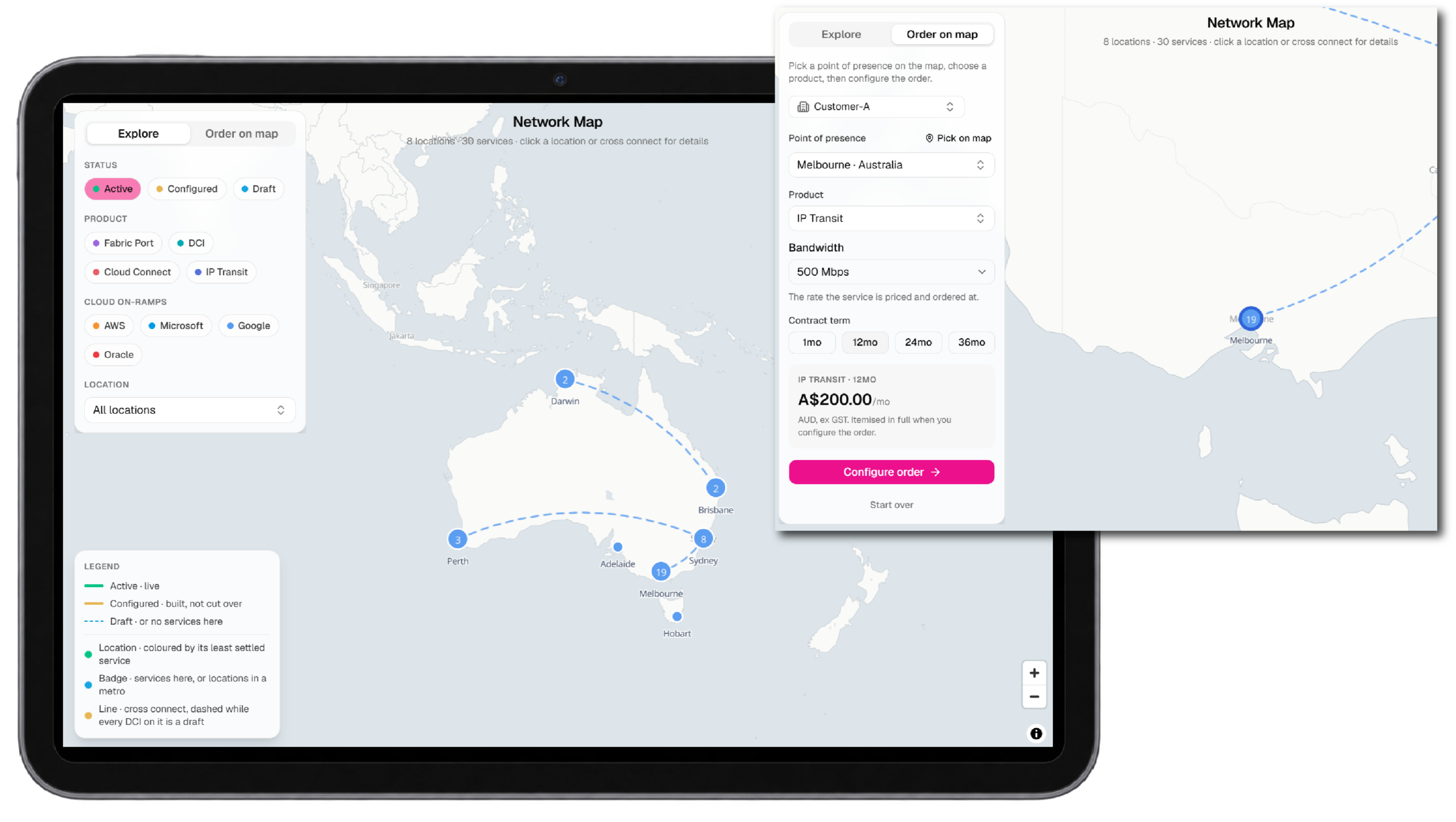
ActivePortal’s map-based interface lets customers explore network locations and configure service orders. *Pricing is demonstration only.
Revenue starts sooner
A signed order does not necessarily mean a service is ready to bill. Manual checks, configuration tasks and handovers can leave a gap between the customer’s decision to buy and the provider’s ability to deliver.
Automated provisioning can shorten that gap. Where resources and integrations are available, services can be activated in minutes, with billing triggered as part of the workflow.
For providers, this accelerates time to revenue. For customers, it means less uncertainty about when their connection will be ready and fewer delays to the projects that depend on it.
Routine requests cost less to deliver
Adding a port, increasing bandwidth or ordering a cloud connection can involve several teams when processes are manual. Sales confirms the request, provisioning configures the service, and support responds to questions about its progress.
A portal backed by orchestration can handle many of these routine steps automatically.
Customers gain more control over ordering and managing their services, while staff spend less time re-entering information and coordinating standard changes. Skilled engineers can focus on complex network designs, service improvements and customer requirements that need their expertise.
As order volumes grow, providers can scale service delivery without increasing manual effort at the same rate.
Fewer handovers mean fewer errors
Each time information moves between people and systems, there is an opportunity for something to go wrong. A mistyped port number, an incorrect bandwidth setting or an incomplete billing record can delay activation and create additional work.
Orchestration reduces these risks by using validated service options and repeatable configuration workflows.
The portal can present choices based on supported products and available resources, helping customers select services the network can deliver. Order details then flow through the provisioning process without being repeatedly re-entered.
Exceptions still need attention, but standard orders become more consistent and easier to manage.
New products become commercially practical
Some services are difficult to sell profitably when every order requires substantial engineering effort.
A temporary connection for a migration, a short-term bandwidth increase or an on-demand link between a data centre and a cloud environment may have clear customer value. But lengthy provisioning processes can make those services impractical to deliver.
Automation changes that calculation.
With orchestration behind the portal, providers can build a catalogue of repeatable services that customers can order when they need them. Activeport supports this approach across products including access ports, data centre interconnect, cloud connectivity, multi-cloud services, partner network services and IP transit.
The portal becomes a channel for selling services that would otherwise carry too much administrative overhead.
The customer journey lives in one place
Customers want a clear view of their services. They want to know what they can order, what it will cost, whether it is active and how to get help.
Moving between separate systems for ordering, billing, service status and support adds friction to that experience.
ActivePortal brings ordering, provisioning, billing, trouble tickets, network visibility, bandwidth policies and customer relationship management into a single interface. Connecting these functions gives customers a more consistent experience and helps providers maintain a clearer view of the customer relationship.
That visibility also reduces the need for customers to contact support for routine updates.
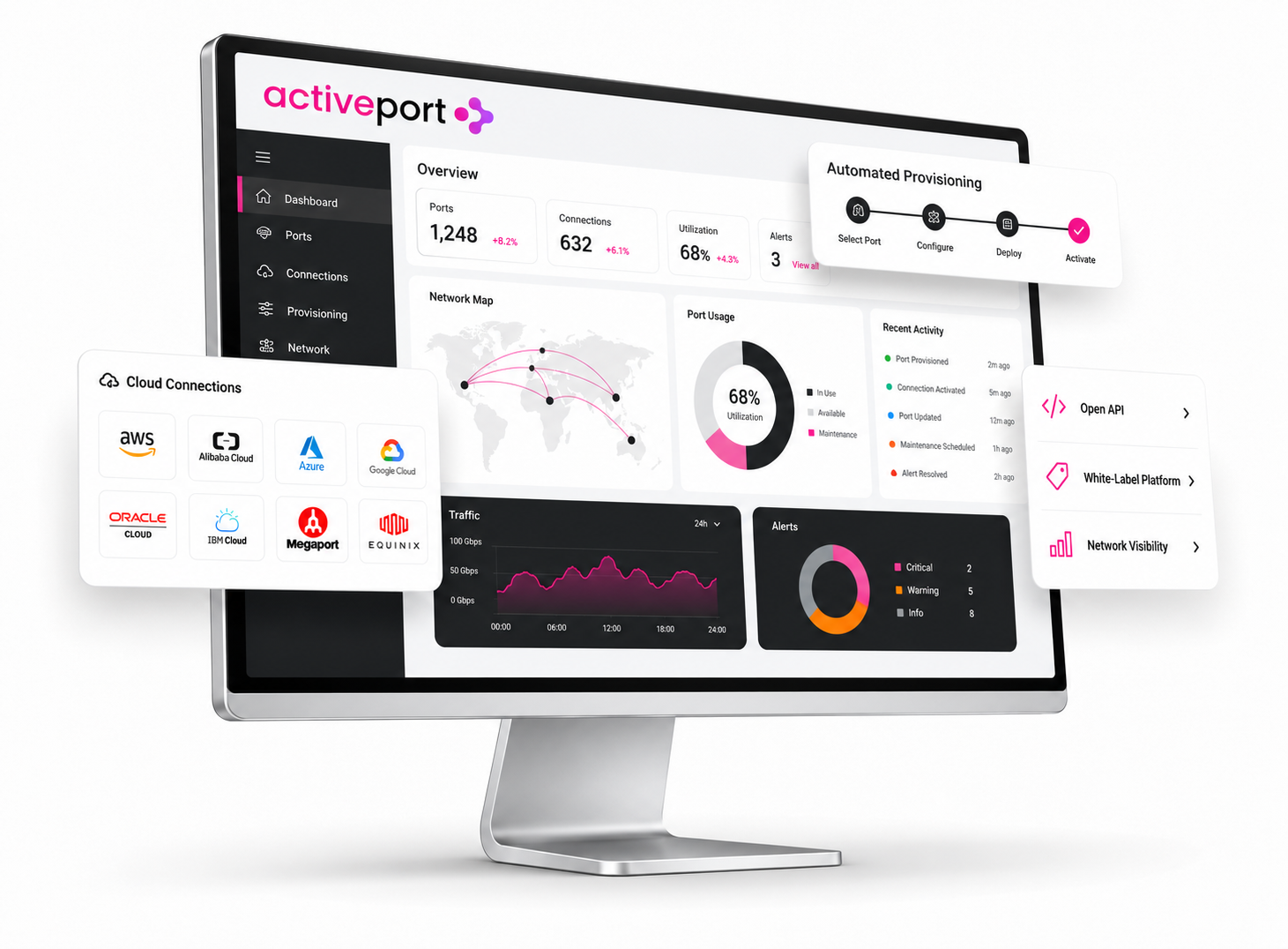
Activeport’s orchestration platform brings network visibility, automated provisioning and cloud connectivity together in one self-service portal.
The experience carries your brand
Activeport’s software is white-labelled, allowing carriers, data centre operators and managed service providers to present the portal as their own.
Customers order and manage services through their provider’s branded environment, including services delivered through supported partner networks.
This gives providers a way to broaden their offering while maintaining a consistent customer experience and a direct relationship with the buyer.
Meeting expectations shaped by the cloud
Enterprise IT teams are accustomed to ordering cloud infrastructure and making changes within minutes. They increasingly expect connectivity to offer similar flexibility.
When a network provider can make services easy to discover, order and activate, connectivity becomes easier to incorporate into a customer’s project plans.
A self-service portal is only as effective as the delivery processes behind it. Connecting that portal to end-to-end orchestration turns it into an active sales and service channel, available whenever customers need it.
Talk to Activeport about creating a branded self-service portal that connects your customers directly to your network services.
